What should a kitchen do when a large party books on top of normal prep?
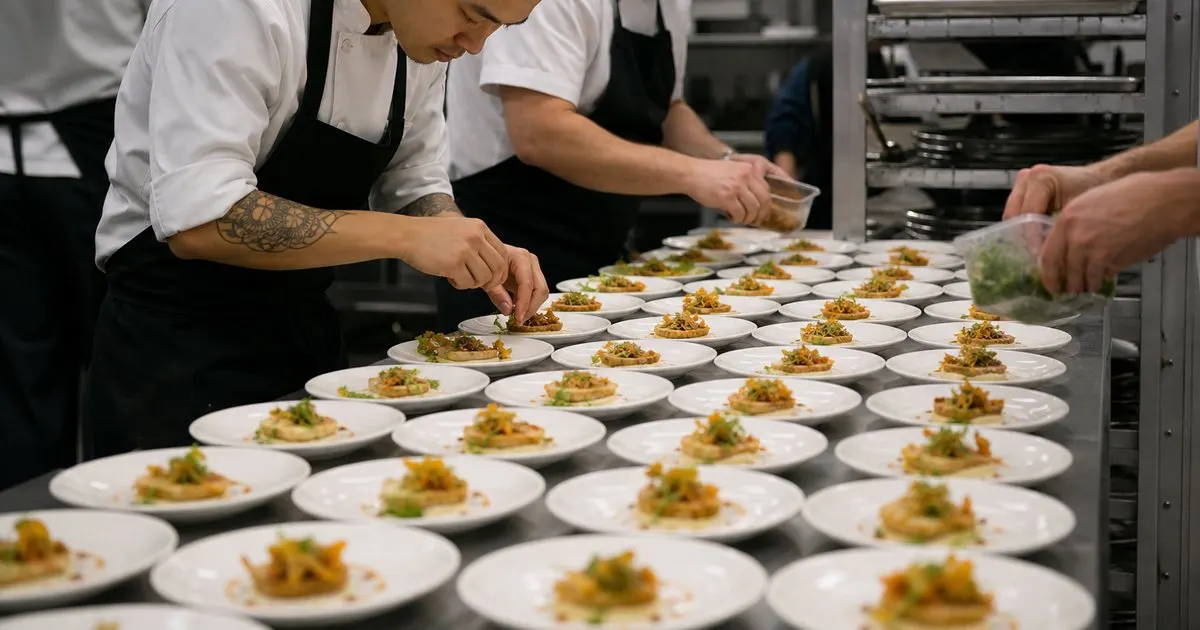
A sixty-top on a Tuesday does not replace your regular prep, it stacks on it. Here is how to add the party without breaking the line or over-prepping for the dining room.
Separate the party from the dining room on paper
The most common mistake is to simply bump every par by some gut-feel percentage because a big group is coming. That inflates items the party will never touch and under-builds the two or three dishes the group actually ordered. A party of sixty eating a set menu is a completely different demand curve from sixty walk-in guests spread across the whole menu.
Build the party as its own prep block with its own quantities, driven by the confirmed menu and headcount, and leave the regular pars alone unless the party also removes seats from normal service. If the group takes half the dining room, regular covers will drop, and the regular pars for that day can come down a little. Keeping the two lists separate makes both numbers defensible and makes it obvious afterward where any waste came from. Related: How do you build a daily prep list from par levels the right way?
Keep reading: How do you build a daily prep list from par levels the right way?, What causes over prep and under prep, and how do you stop both?, How should you assign prep tasks across stations so nothing gets missed?. See how PrepDeckr helps you kitchen prep lists and par-based prep sheets.
Work backward from the menu and the headcount
Start with the party menu and the guaranteed count, then convert each dish into prep components using your recipe yields. A plated salad course for sixty means sixty portions of greens, dressing, and garnish, plus a small buffer for plating errors and last-minute adds. Family-style service needs more per person than plated because guests serve themselves unevenly. Buffets need more still, and the last guests through the line should see full pans, which means over-building somewhat by design. Related: What causes over prep and under prep, and how do you stop both?
Once each dish is broken into components, look for overlap with your regular prep. If the party's chicken uses the same marinade as the menu chicken, one larger batch is more efficient than two. If the party's dessert is a one-off, it gets its own line and its own timing. Write the party components on the sheet with the party name and the service time so nobody accidentally uses party prep for the line on the night before. Related: How should you assign prep tasks across stations so nothing gets missed?
Move the timing, not just the quantities
A party changes when things need to happen, not only how much. Components that hold well should be pushed to the day before or the morning of, so the hour before the party is spent plating and firing rather than chopping. Anything that has to be finished close to service should be listed with a firm start time. When the party arrives at seven, "prep the sixty salads" is not a task. "Plate salads starting 6:15, hold in walk-in on sheet trays" is.
This is also where you decide who does what. A party usually needs one person pulled off regular prep for a few hours, so that person's normal tasks need to be reassigned or done earlier. If you do not write that reassignment down, those tasks will be discovered missing at 5 p.m. Make the party block its own section on the sheet with an owner and start times, and check it separately from the regular list. Related: How do you make a prep list any lead can run when you are out?
Close the party out and learn from it
After the event, count what is left from the party block before it gets folded back into regular stock. If forty portions of dessert remain from a party of sixty, your per-person assumption was wrong, and that is worth knowing before the next booking. If you ran out of a course, note it and note whether the headcount came in above the guarantee.
Keep a short record per party: menu, guaranteed count, actual count, what ran short, and what was left. After a handful of events you will have honest per-person numbers for your own dishes and service styles, which are far more useful than anything generic. Those numbers make the next party quote faster and the next prep block more accurate.
- Build the party as its own prep block instead of inflating every regular par.
- Convert the party menu and headcount into components with recipe yields, with a buffer sized to the service style.
- Assign start times and an owner to the party block, and reassign the regular tasks that person would have done.
- Count party leftovers separately and keep a short record per event to sharpen future per-person numbers.

Julien Jimenez
Julien Jimenez is an independent software builder based in Paris. He designs, ships, and operates focused SaaS products for small businesses and independent professionals. Read the full author page.
Build Prep Lists That Match The Day
Kitchen prep lists and par-based prep sheets. PrepDeckr is built to help you put this into practice.
Start free trialMore from the PrepDeckr blog
How do you build a daily prep list from par levels the right way?
What causes over prep and under prep, and how do you stop both?
How should you assign prep tasks across stations so nothing gets missed?
Get the PrepDeckr playbook
Practical guides on kitchen prep and production, straight to your inbox as we publish them. No spam, unsubscribe any time.